
Muskegon County Criminal History Checks
No single search holds the complete Muskegon County criminal history picture. Begin with the event you need to understand. MiCOURT has separate searches for the 60th District Court and 14th Circuit Court. The county jail portal reports current or recent local custody. ICHAT is the Michigan State Police name-based repository search. Each source answers a narrower question, so a careful check uses more than one when a record could have moved from arrest to court or state supervision.
Gather the full name, middle name, date of birth, spelling variants, and any case number before searching. A date of birth is useful when two people share a name. Save the court number once found because it is the best key for asking the clerk for a copy. Do not treat a blank result as a no-record certificate. Restricted records, reporting lag, release from custody, and a search in the wrong court can all produce an empty screen.
- Search D60 in MiCOURT for misdemeanors and the first stage of every felony.
- Check C14 when a felony was bound over to Circuit Court.
- Use the sheriff’s inmate portal for current custody and recent booking details.
- Run ICHAT for the public statewide repository slice, then compare each disposition with the court file.
- For your own strongest identity match, request the Michigan State Police fingerprint record.
Five Muskegon Criminal Record Systems
One person’s name may appear in five official systems for five different reasons. MiCOURT records prosecution events. The Zuercher jail portal shows local custody. ICHAT joins eligible fingerprinted arrest cycles with Michigan dispositions. OTIS covers current Michigan Department of Corrections prisoners, parolees, felony probationers, and generally people discharged within three years. PSOR shows only registry information that Michigan law makes public.
| System | Best question | Main limit |
|---|---|---|
| MiCOURT D60/C14 | What happened in a Muskegon court case? | A docket entry may not include the filed document. |
| Zuercher | Is the person in Muskegon County Jail? | It is not a full arrest history. |
| ICHAT | What public Michigan repository history matches the name? | Warrants and several record classes are excluded. |
| OTIS | Is the person under MDOC custody or supervision? | County-jail-only custody is absent. |
| PSOR | Does Michigan publish a registration profile? | It is not the full law-enforcement registry. |
The Michigan State Police criminal-history page illustrates the split between ICHAT and fingerprint review.
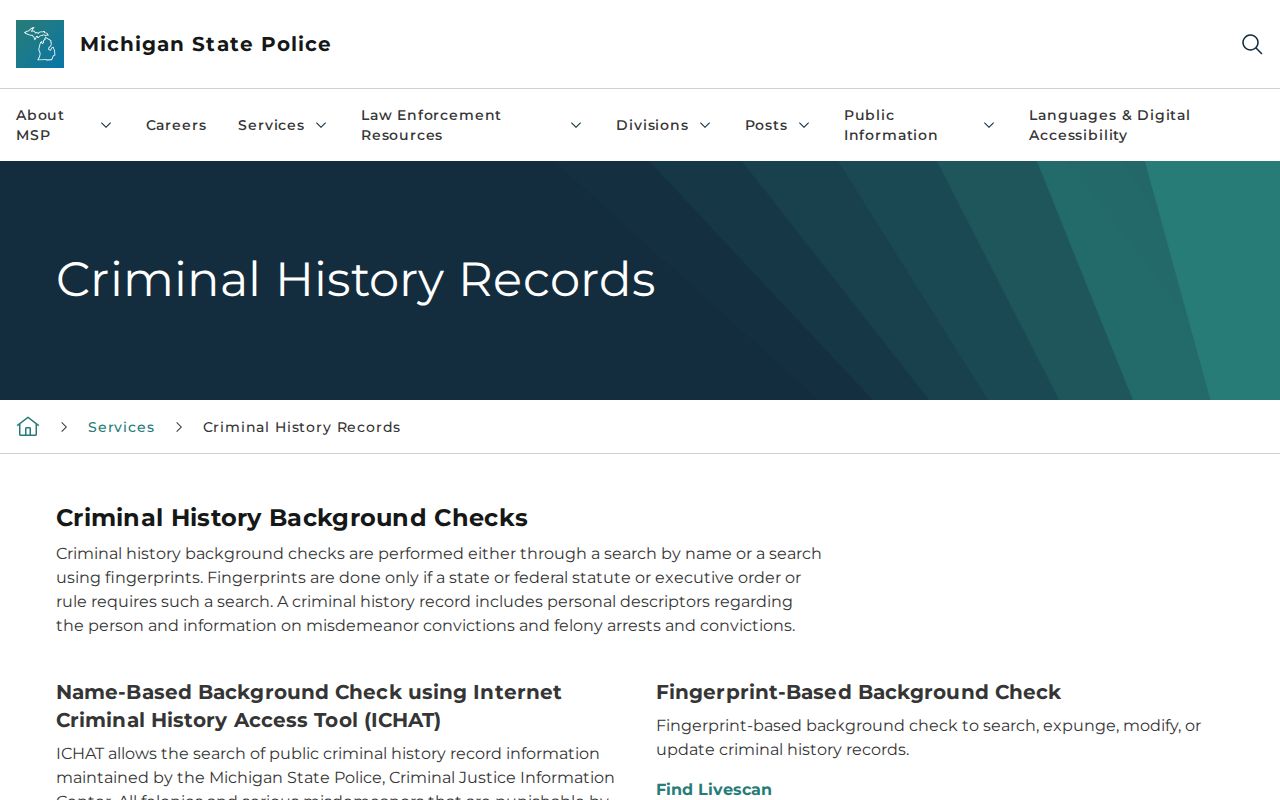
That choice matters because a name match offers speed, while fingerprints provide a stronger link to the person reviewing their own record.
Official Background Checks in Michigan
The Michigan State Police Criminal Justice Information Center keeps the central criminal-history repository. Its Internet Criminal History Access Tool, or ICHAT, permits a public name search for $10. The result can include reportable felony arrests and convictions and serious-misdemeanor convictions. It excludes warrants, federal and tribal matters, out-of-state cases, traffic and juvenile matters, suppressed entries, and local nonreportable misdemeanors. That scope makes ICHAT useful, but not complete.
A person reviewing their own full Michigan record can submit an FD-258 or similar fingerprint card to MSP CJIC with the required cover letter and $30 fee. MSP states a three-to-five-week period including mail. One certified or notarized original is included, and each additional original is $1. The FBI Identity History Summary is a separate subject-only federal process. A lawfully required Michigan applicant fingerprint check uses the requesting authority’s form and purpose code through IdentoGO/IDEMIA. The code must come from that authority.
- ICHAT
- A $10 name-and-descriptor search of the public Michigan CJIC slice.
- MSP personal record
- A $30 fingerprint review of public and nonpublic Michigan history linked to the submitted prints.
- MiCOURT
- A free name or case-number search of public records in the selected Muskegon court.
- FBI Identity History Summary
- A fingerprint-based, subject-only review of FBI-maintained history at the current federal transaction fee.
Muskegon Criminal Record Counters
The Michael E. Kobza Hall of Justice concentrates several record holders at 990 Terrace Street, yet each has a distinct counter. D60 occupies Suite 100 and handles misdemeanors plus early felony stages. Circuit Court Records is on the sixth floor in Suite 600 and keeps bound-over felony files. Sheriff headquarters is on the fourth floor in Suite 450. A request addressed only to “the courthouse” may reach the building but not the custodian.
60th District Court
Suite 100
990 Terrace Street
Muskegon, MI 49442
231-724-6294
Weekdays, 8:30 a.m. to 4:30 p.m.
14th Circuit Records
Sixth Floor, Suite 600
990 Terrace Street
Muskegon, MI 49442
231-724-6251
Weekdays, 8:00 a.m. to 4:30 p.m.
County Sheriff
Fourth Floor, Suite 450
990 Terrace Street
Muskegon, MI 49442
231-724-6351
Visitors pass security screening. Older circuit criminal files may be off site, so files from before 2013 should be requested at least five days ahead. Circuit Records asks callers to leave one clear message with a callback number, full party names, and case number. Several messages can slow the response.
Kinds of Criminal Records
Record type follows the public office that created the information. Police write incident and arrest reports. The Muskegon County Jail records intake, housing, holds, and release. Prosecutors file charges, while D60 and C14 preserve what happened in court. CJIC links reportable fingerprint transactions with later dispositions. MDOC keeps prison, parole, and felony-probation data. MSP manages PSOR.
These files do not become interchangeable because they concern the same event. An original arrest label may change when the prosecutor reviews the report. A jail row may disappear after release while the MiCOURT case remains. ICHAT may omit a local misdemeanor that D60 still displays. Use the record nearest to the fact being checked.
- Arrest and booking records: agency reports and county custody entries describe the first stage.
- Court case files: charges, hearings, pleas, orders, dispositions, and sentence belong to D60 or C14.
- Repository records: CJIC pairs eligible fingerprinted arrest cycles with reported outcomes.
- Warrants: the issuing court and law enforcement confirm current status; ICHAT does not include them.
- Supervision and registry records: OTIS and PSOR answer narrow statutory questions, not a full history.
Muskegon Jail Records Versus OTIS
The Muskegon County Jail opened in 2015 with 542 beds. Its free Zuercher portal is available around the clock and can filter by name, race, sex, cell block, arrest date, held-for agency, custody date, or release date where enabled. A result may show a photograph or placeholder, displayed name, basic descriptors, cell block, arrest and release dates, holding agency, and hold reasons. It remains a list, not a complete booking file or proof of guilt.
OTIS begins at a different line. It covers people under MDOC prison, parole, or felony-probation supervision and generally retains discharged people for three years. It does not show everyone held only in Muskegon County Jail. The official OTIS search shows the state correctional layer.
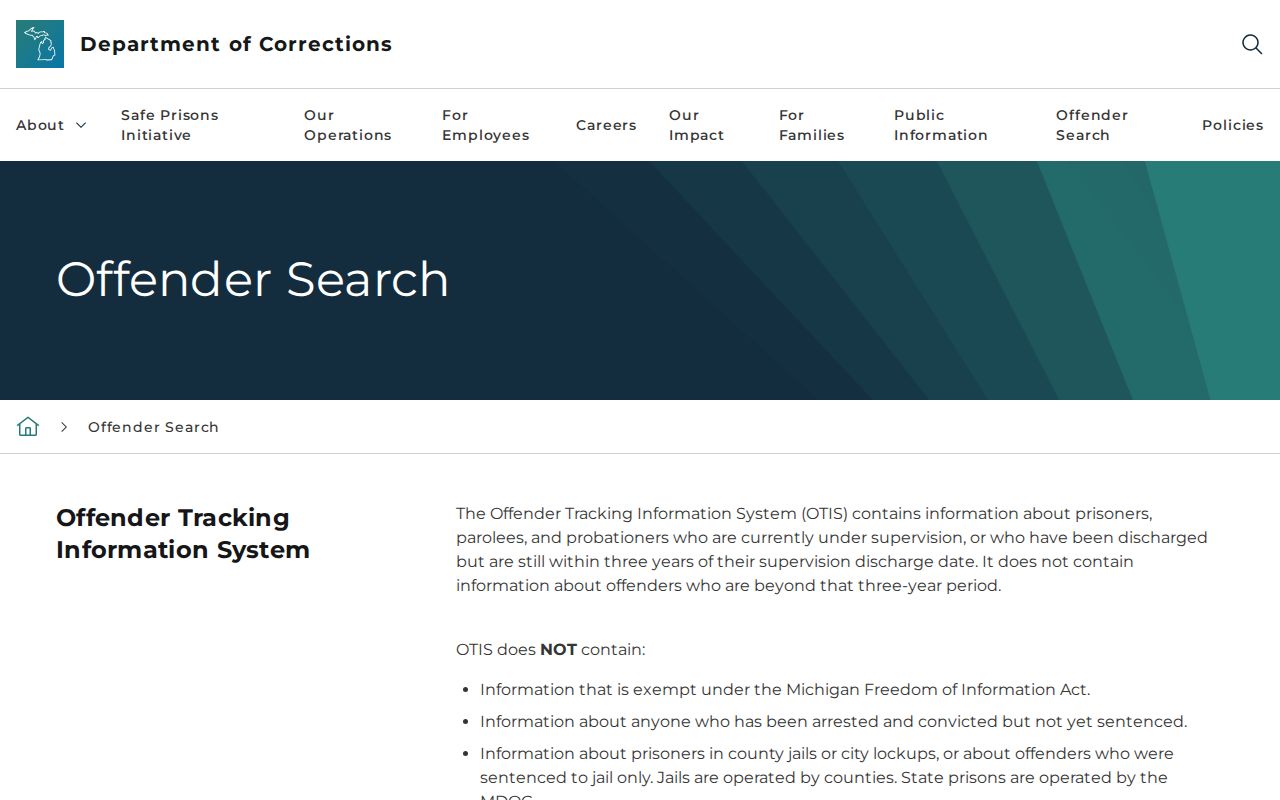
The MDOC limitations explanation is equally important.
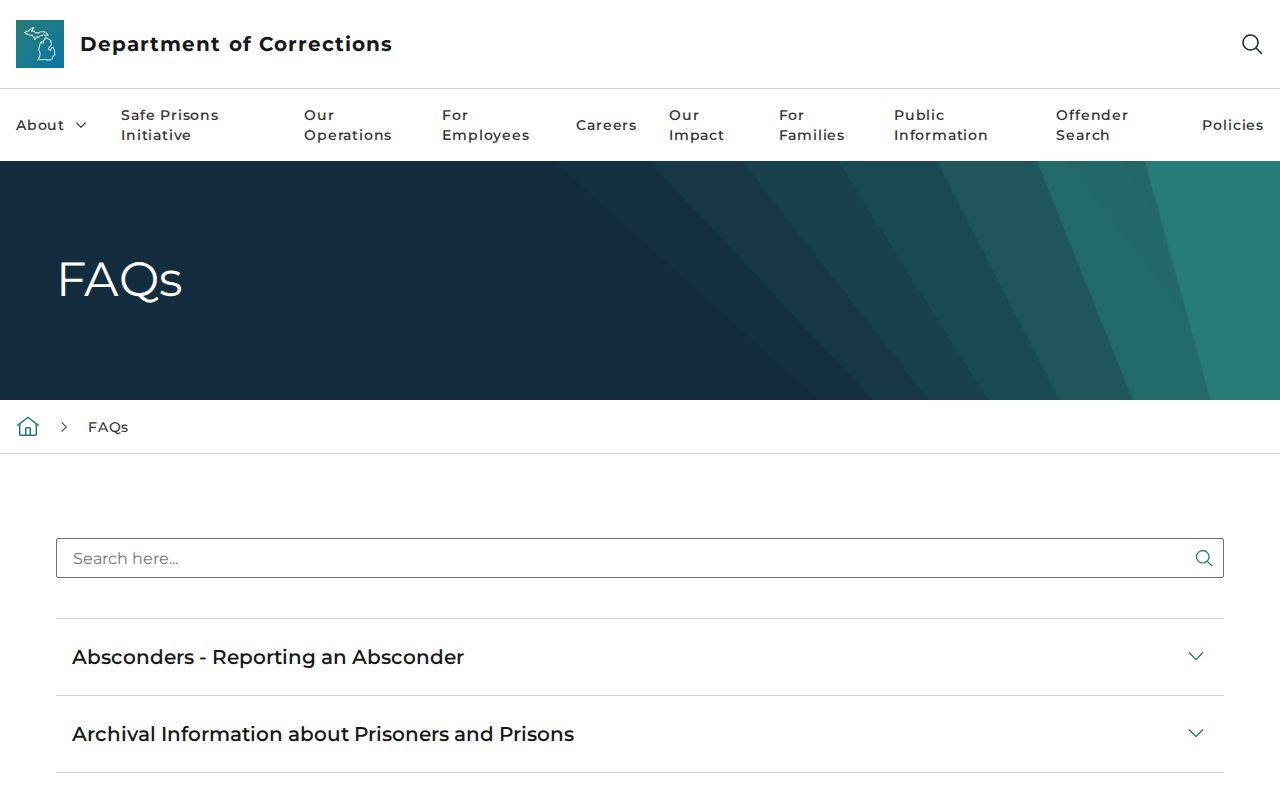
Together, the two state pages make clear why an OTIS search cannot stand in for the jail portal, MiCOURT, or ICHAT. VINE adds custody-change notices, but it is not a historical arrest file.
Muskegon County Criminal Records: What They Contain
A Michigan fingerprint record is arranged around identity and arrest cycles. It may connect names and aliases, date of birth and lawful descriptors, the arresting agency, transaction tracking, charges, the court case, disposition, sentence, and supervision updates. Public ICHAT results suppress nonpublic identifiers. MiCOURT provides a deeper event history, and the jail portal focuses on live custody.
| Name & Identifiers | Displayed names, aliases, date of birth, and limited descriptors used to separate similar identities. |
|---|---|
| Arrest / Booking Data | Arrest date, creating agency, initial authority, holds, housing, and release fields where public. |
| Charges & Statutes | Count description, Michigan citation, offense level, and offense date as filed. |
| Disposition | The count-level result, such as conviction, dismissal, acquittal, or another final action. |
| Sentence | Jail, prison, probation, financial terms, or other ordered sanctions shown in the court file. |
| Custody / Supervision Status | County custody, MDOC imprisonment, parole, or probation where the responsible system publishes it. |
“Disposition” means the court’s outcome for a charge. “Bindover” is the transfer of a supported felony from D60 to C14. A “register of actions” is the dated event list, not the full set of pleadings. Those distinctions help a reader avoid treating the first result row as the whole case.
Muskegon Arrest and Conviction Chain
An arrest creates four linked but separate Muskegon criminal records. The arresting agency writes the report. The jail opens a booking entry. The prosecutor chooses whether and what to charge, and D60 opens the court case. For a reportable arrest, fingerprints reach CJIC; court and prosecutor disposition reports later let CJIC match an outcome to that cycle.
Record flow: Police report › jail booking › D60 case › C14 after felony bindover › CJIC disposition match.
The chain can break or lag. A city police report stays with the city under the county’s shared records agreement even if the person entered the county jail. Charges can be changed or declined. Historic disposition data may not pair at once with fingerprints. When records conflict, compare the exact case number and count, request the court disposition, and use MSP’s fingerprint self-review for your own identity. Correction fixes inaccurate data; set-aside relief changes public access to an accurate eligible conviction.
Michigan Public Access Laws
The Michigan Freedom of Information Act governs executive-branch records held by the county, sheriff, and police departments. A public body usually must respond within five business days by granting, denying, partly granting, or issuing a written extension of up to ten business days. Response time is not always production time. Courts use MCR 8.119 and clerk procedures instead of county FOIA. Repository, registry, and set-aside access also follow their own statutes.
Key Statutes:
MCL 15.231 states Michigan’s public policy favoring access to public-body records.
MCL 15.235 sets the FOIA response choices and timing framework.
MCL 28.243 addresses disposition reporting and certain fingerprint return or destruction duties.
MCL 780.621g establishes Michigan automatic set-aside provisions.
Exempt parts may be redacted while separable public parts are released. Active investigations, confidential techniques, juvenile material, victim privacy, personal identifiers, and security data can limit disclosure. A denial should cite its legal basis and describe review rights.
Muskegon Criminal Records FOIA Clock
The county’s FOIA request route is the fallback for sheriff reports and booking details not published online. Select the creating department, give a narrow date range, location, event or booking number, involved name when appropriate, and the exact item sought. Ask for an electronic copy if available. Court pleadings go to the court clerk, not this portal.
| Channel | Use | Cost or timing |
|---|---|---|
| County FOIA portal | Sheriff-created reports and releasable booking material | No filing fee; permitted fulfillment costs may apply |
| Hall of Justice counter | Correct sheriff or court custodian | Copy and search charges depend on the record |
| Circuit Court copies | Filed C14 documents | $1 per page plus $10 per certified document |
| Jail lookup | Current custody | Free and available 24/7 |
The Muskegon County Sheriff services hub connects the public channels.
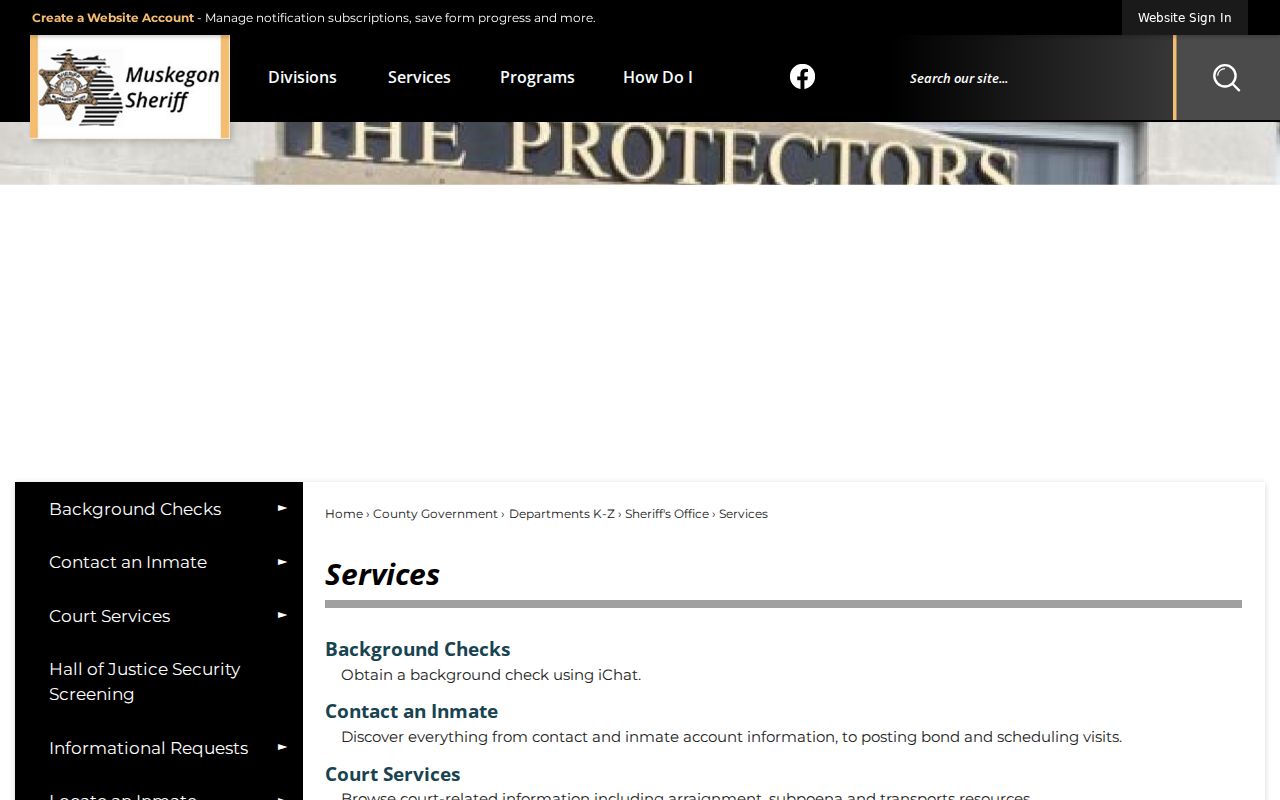
The service list helps route a request before the response clock begins, reducing the chance that the wrong public body receives it.
Restricted, Sealed & Set-Aside Records
Michigan restricts juvenile files, victim identifiers, nonpublic repository material, sensitive account data, and qualifying convictions that have been set aside. A set-aside, often called expungement, makes a conviction nonpublic but does not erase every government record. Application eligibility, exclusions, waiting periods, and automatic Clean Slate relief are controlled by MCL 780.621, 780.621c, 780.621d, and 780.621g.
The wait period runs from the latest controlling event defined by law, such as sentence, release, or discharge from supervision, rather than the arrest date alone. An application normally goes to the court of conviction. A D60 conviction stays in D60; a bound-over C14 felony returns to Circuit Court. Certified conviction records and fingerprints are part of the filing route. After an order, verify that the court and CJIC processed it.
Muskegon Clean Slate Record Mismatches
Automatic relief depends on statutory rules and data matching. A record that appears eligible may remain public when identity or disposition data do not align. The MSP Clean Slate record-review page compares the three ways to see what remains.
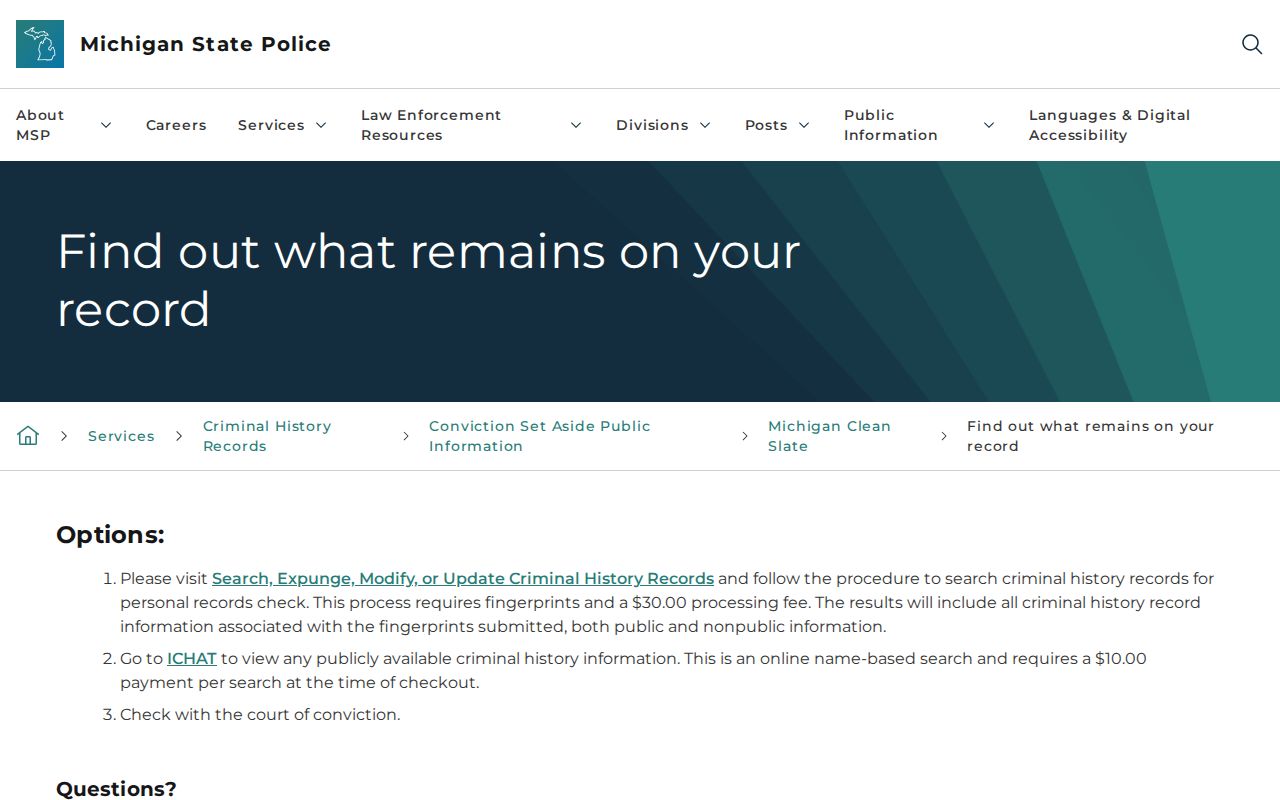
For an apparent error, first obtain the exact D60 or C14 disposition and an identity-confirmed fingerprint response. Give the court and MSP the order and case number. A FOIA request is not the right tool for correcting a CJIC entry, and correction is distinct from asking a court to set aside an otherwise accurate conviction.
Federal Criminal Records Beyond Muskegon
Federal cases from Muskegon County belong to the U.S. District Court for the Western District of Michigan, not D60, C14, or ICHAT. PACER is the official federal docket and document service after registration. The FBI Identity History Summary is the subject-only fingerprint channel. The Bureau of Prisons locator covers federal custody, while OTIS covers Michigan correctional supervision.
The Western District of Michigan court site identifies the federal court layer.
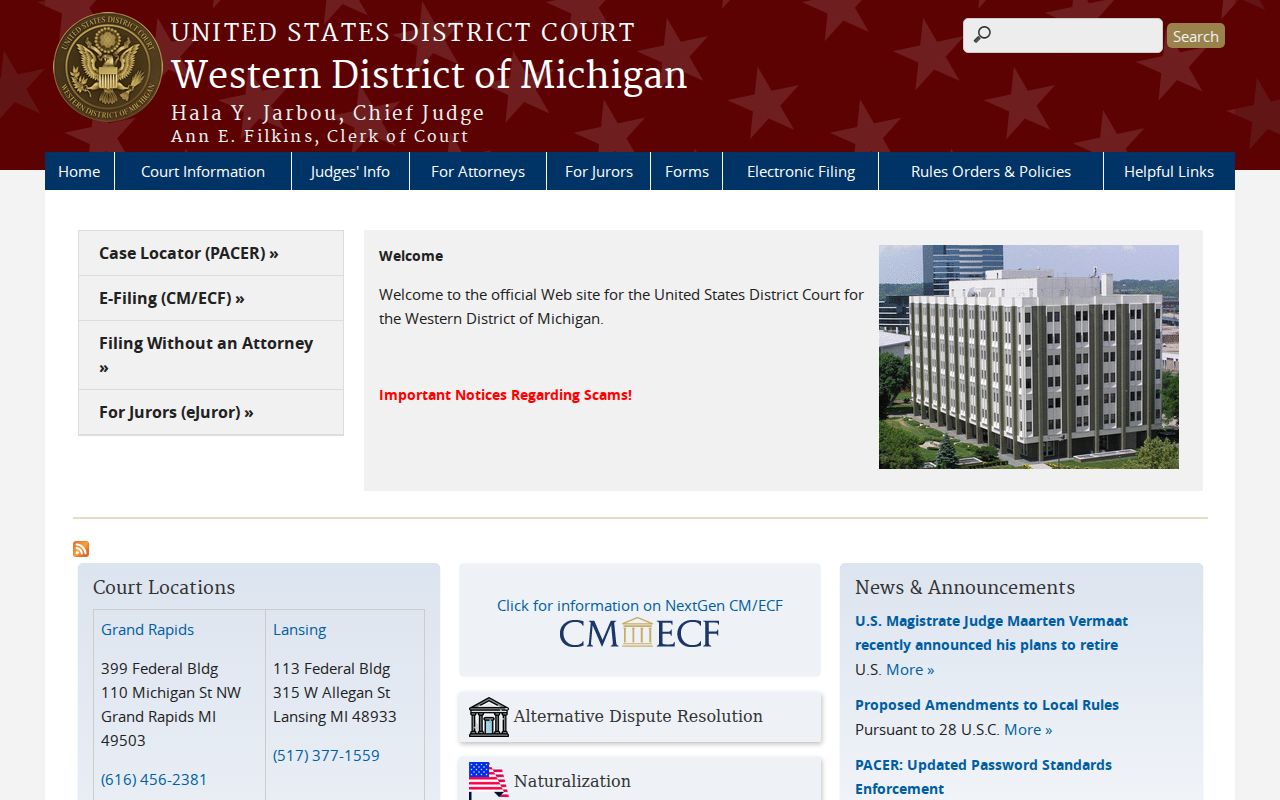
A blank PACER name result or BOP search does not prove that no federal warrant exists. Warrant confirmation belongs with the issuing court or law enforcement. Keep federal and state search results separate when assembling your own history.
Muskegon County Warrant Record Search
Muskegon County does not publish a confirmed public active-warrant database. ICHAT also excludes warrants. For a possible misdemeanor, failure to appear, or pre-bindover matter, search D60 and call its criminal division at 231-724-6258. For a bound-over felony, search C14 and call Circuit Records at 231-724-6251. The sheriff at 231-724-6351 can give safe verification instructions, and a narrow county FOIA may request releasable warrant information.
Do not rely on an old screenshot. Verify the court, case number, and live status; ask what bond, appearance, or surrender process applies; follow the court’s instruction; keep the receipt or recall order; then recheck the register after processing. OTIS can label an MDOC absconder, but it is not a warrant search. Silent Observer accepts tips and is not a personal warrant-clearance line.
Note: Arrest, bench, search, and supervision warrants arise from different events and can have different public-access limits.
Muskegon Criminal Case Support Offices
The Muskegon County Prosecutor decides whether and what to charge after police submit a warrant request. Its divisions include district, circuit, family, appellate, victim services, warrant intake, and digital-evidence support. The prosecutor’s office is at 990 Terrace Street, Suite 550, with a main number of 231-724-6435. Victim Services can be reached at 231-724-6676.
The Office of the Public Defender opened in 2014 and uses a Holistic Defense model that includes social workers. It represents eligible appointed clients who face loss of liberty, but it is not a public record-search desk. The criminal division is reached at 231-724-6585. The county Public Defender page explains that role.
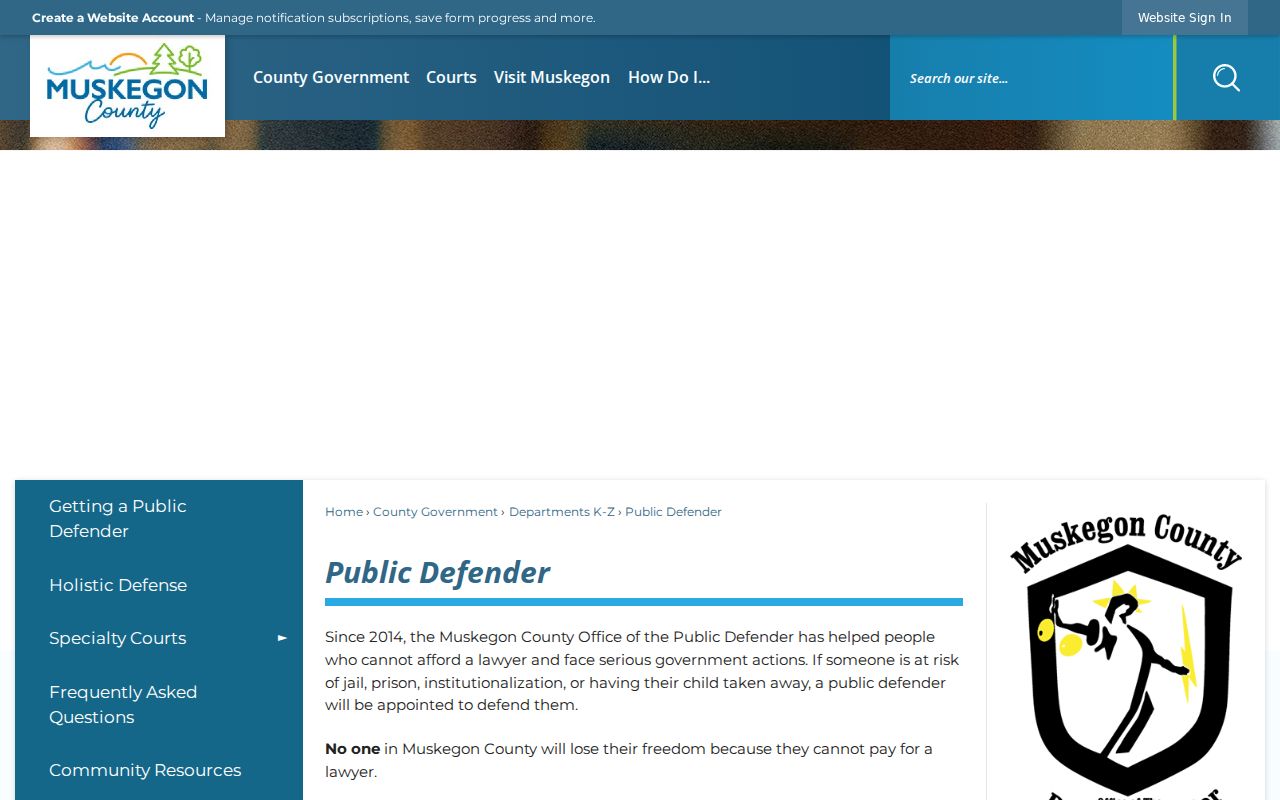
The office image belongs in the case-support context because legal representation and public record access are separate functions, even when both relate to the same charge.
City-by-City Criminal Records in Muskegon County
Muskegon, Norton Shores, and Muskegon Heights are the county’s three largest incorporated cities. Each police department owns the reports it creates, even though a person may be booked at the county jail. None has a separate municipal criminal court. Criminal prosecutions from all three begin at D60, with a felony moving to C14 only after bindover.
Muskegon Record Check
37,287 · City Police Records handles reports; D60 handles criminal cases.
Norton Shores Record Check
25,070 · The Henry Street Records Bureau supplies local reports.
Muskegon Heights Record Check
9,806 · City police owns incident files; county courts hold cases.