
Criminal Court Cases in Muskegon County
Every Muskegon County criminal prosecution starts in the 60th District Court. D60 handles misdemeanors from arraignment through sentence. It also handles a felony complaint, arraignment, probable-cause conference, and preliminary examination. If probable cause is found or the examination is waived, the felony is bound over to the 14th Circuit Court. The bindover creates a circuit file under a new court number. That means one felony matter can have linked D60 and C14 records.
The court clerk, not the sheriff, is the custodian of pleadings, orders, judgments, and the register of actions. D60 is in Suite 100 at 990 Terrace Street. Circuit Court Records is on the sixth floor in Suite 600 at the same Muskegon address. A police report or booking entry does not replace either court file. It records what happened before the prosecutor chose the counts that were actually filed.
The offices share the Michael E. Kobza Hall of Justice, but that common address does not make their files interchangeable. A request labeled only “courthouse” may reach the wrong counter. Direct a misdemeanor or early felony question to D60. Send a bound-over felony file request to Circuit Court Records, with the case number whenever possible.
Two Muskegon County Case Records
Search D60 first when the court level is unknown. A misdemeanor remains there. A felony searcher should read the district register for the first appearance, bond, probable-cause conference, and preliminary examination. A bindover entry signals that the next part belongs in C14. The circuit register then tracks the information, circuit arraignment, motions, plea or trial, judgment, and sentence.
This split avoids a common mistake. A D60 felony charge does not guarantee a later circuit case. Muskegon County reported that 62 percent of felonies charged in 2023 were resolved in District Court. Some counts can be dismissed, reduced, or otherwise conclude before bindover. The D60 disposition and register must be read before assuming that a missing C14 result is an error.
Muskegon County Case Record Searches
MiCOURT Case Search is the main remote channel for public Muskegon County case records. Select court D60 first, then court C14 when the district register shows a felony bindover. Name searches work best with a full first and last name plus a middle name or birth date when the interface permits it. An exact case number is stronger because numbers are court-specific.
- Open MiCOURT, accept its terms, and choose 60th District Court, code D60.
- Use the Name tab with enough identity detail, or enter the exact district case number.
- Open the result and read its status, charges, scheduled events, and full register of actions.
- If the register shows bindover, repeat the search under 14th Circuit Court, code C14.
- Ask the correct clerk for a plain or certified copy when the register names a document but does not display it.
| Field Label | Type | Required | Notes |
|---|---|---|---|
| Court | Court choice | Yes | Choose D60 or C14 and search both for a bound-over felony. |
| Search Type | Tab or radio | Yes | Choose Name or Case Number. |
| Last Name / Business Name | Text | Name search | Do not assume partial-name behavior. |
| First and Middle Name | Text | No | These fields can narrow a common surname. |
| Date of Birth | Date | No | Use MM/DD/YYYY when known and available. |
| Case Number | Text | Number search | Enter the exact court case number. |
MiCOURT Muskegon Case Search Views
The official D60 MiCOURT search shows the name and case-number routes used to find district matters. The captured court screen below helps distinguish a portal search from a request for the actual file.
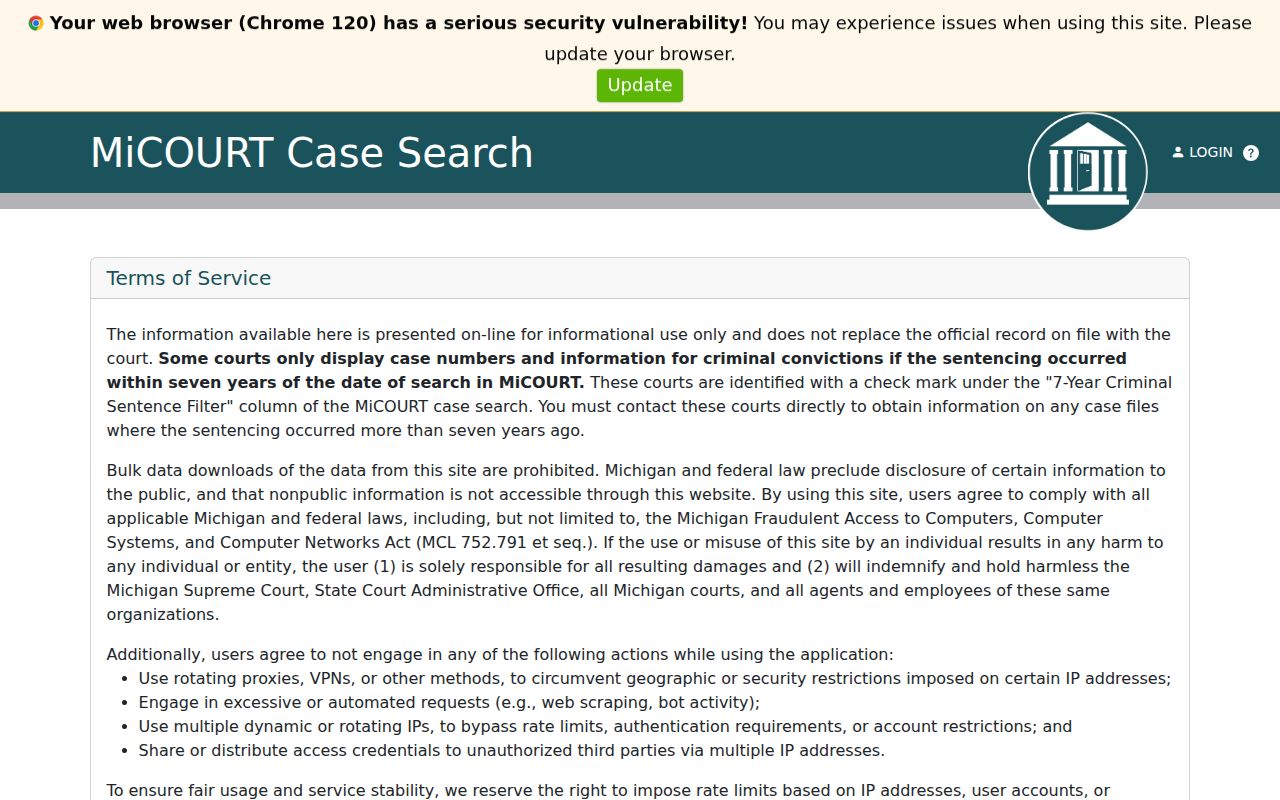
The selected court matters. A result in D60 can contain the whole misdemeanor record or only the opening stages of a felony prosecution. For a felony that moved forward, the C14 MiCOURT search provides the circuit side.
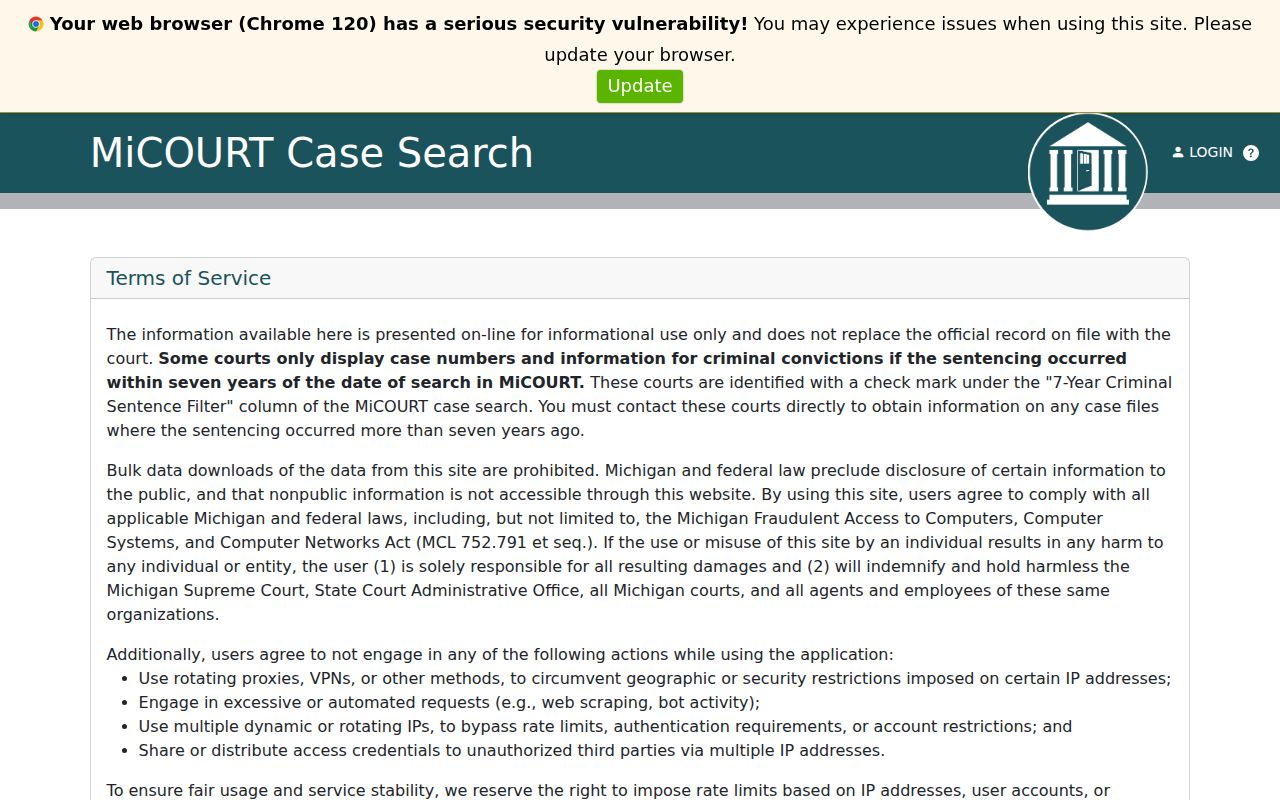
Using both Muskegon County court choices links the early felony events with the later circuit disposition without treating either result row as the complete case file.
What a Criminal Case File Contains
A Muskegon County case result can show the case caption, filing date, status, party role, charges, statutes, hearings, judge, and public attorney information. Its register lists events in date order. Yet a register entry is only an index to an event or document. It is not the complaint, motion, order, or judgment itself. Request the named item from the court clerk when the document text matters.
| Case Number & Court | Identifies D60 or C14 and keeps same-name cases separate. |
|---|---|
| Charging Document | The district complaint or the circuit information states the filed counts. |
| Register of Actions | Lists public filings, hearings, rulings, warrants, pleas, and other case events by date. |
| Charge Details | May show each count, statute, level, offense date, and count-level result. |
| Disposition & Judgment | Shows whether a count ended in conviction, dismissal, acquittal, or another recorded result. |
| Sentence & Conditions | Records the court-ordered sanction, costs, restitution, probation, or custody terms when public. |
Older Muskegon County Court Files
Muskegon County criminal files from 2013 forward are normally the on-site group at Circuit Court Records. An older file may be stored off site. The clerk asks for at least five days to retrieve it before delivery or notice. Searchers should call before traveling, give the full case-party names, and provide the case number if known. Repeated voicemail messages can slow the callback.
Circuit Court Records accepts requests at its Suite 600 counter and by mail. Plain copies cost $1 per page. Certification adds $10 per document. The clerk cannot certify a document brought in by a visitor. A card payment for requested documents can use GovPay or AllPaid with location code 5115, but the processor discloses its own service fee during payment.
Note: Order a pre-2013 Muskegon County criminal file before visiting because its paper record may not be stored at the public counter.
Criminal Case Stages in Muskegon County
A case can begin with an arrest, citation, or complaint, but the court file starts with charges filed in D60. At arraignment, the charge and rights are stated and bond can be addressed. A felony next reaches a probable-cause conference and preliminary examination unless that hearing is waived. Bindover transfers the case to C14. The prosecutor then files the circuit information, and the circuit judge handles later motions, trial or plea, judgment, and sentence.
Case flow: Charges Filed › Arraignment › Pretrial › Plea or Trial › Disposition › Sentencing
Muskegon County specialty pathways may include sobriety or drug treatment, mental-health, and veterans-oriented programs when current court rules support admission. Participation alone does not prove dismissal or set-aside relief. Read the register and final disposition to learn how the case ended.
Reading Muskegon County Case Events
Michigan court terms mark where a case sits. An arraignment is the first formal appearance. A probable-cause conference prepares a felony for negotiation or examination. A preliminary examination tests whether probable cause supports transfer. Bindover means that the felony leaves the district phase for circuit court. The information is the circuit charging document.
- Disposition
- The recorded result of a charge, such as conviction, dismissal, or acquittal.
- Nolle prosequi
- A prosecutor's formal choice not to continue a charge; it is not a conviction.
- Register of actions
- The date-ordered event list, not the full set of filed documents.
- Count
- One separately alleged offense within the same case.
- Bench warrant
- A judge-issued warrant that may follow failure to appear or comply with an order.
A charge label at filing can change through amendment, plea, trial, or dismissal. The count-level disposition and judgment give a sounder answer than the case title alone.
Access Rules for Case Records
Michigan Court Rule 8.119 governs court record access and management. Public Muskegon County files can be inspected through the clerk's process, but the rule also recognizes nonpublic material. Juvenile matters, victim information, protected personal identifiers, sealed files, and set-aside records can be withheld, removed from public search, or redacted.
A blank MiCOURT search does not establish that no government record exists. The name may differ, the case may be old or off site, the matter may be restricted, or the selected court may be wrong. Contact D60 for a misdemeanor or pre-bindover matter. Contact Circuit Court Records for the file after felony bindover. County FOIA is not the route for court pleadings because the courts administer their own records.
Online redaction can also make the public screen less detailed than a clerk-held file. Ask for a specific public document rather than a broad explanation of the case. Clerks can supply records within their custody, but they do not interpret a judgment, predict an appeal, or give legal advice about what an entry means for a party.
Missing Muskegon County Case Dispositions
A court outcome can appear in MiCOURT before it is paired with the arrest cycle held by the Michigan State Police Criminal Justice Information Center. When an ICHAT entry lacks a result, compare the exact name, birth date, arrest, court number, and count-level disposition. Then obtain the judgment or dismissal from the court that decided the charge.
For review of one's own identity-confirmed Michigan record, MSP's fingerprint process is stronger than a name match. A missing or incorrect disposition should be addressed through the court, prosecutor, and MSP record update instructions. Correction fixes inaccurate data. It is different from a set-aside, which changes public access to an eligible and accurate conviction.